
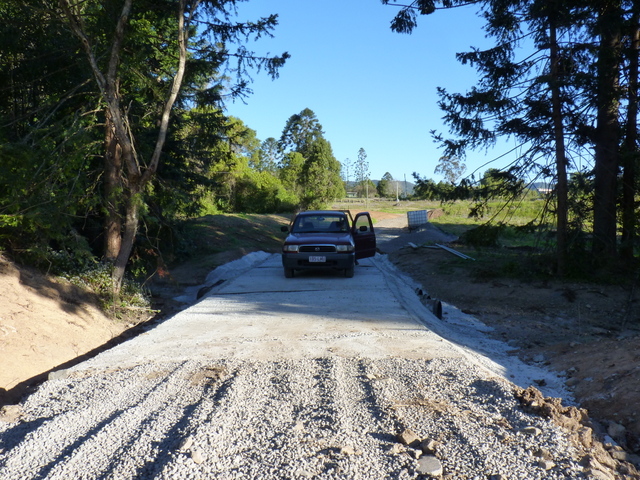
A road is only as good as the bit that fails. The most likely place for failure of our road is the main gully crossing. Well perhaps not fail exactly, more likely disappear. There are times when there is a great deal of water through there and a great risk that, left to its own devices, our causeway would disappear down the Mary River every time there is a flood. So, there needed to be concrete and fair bit of that.
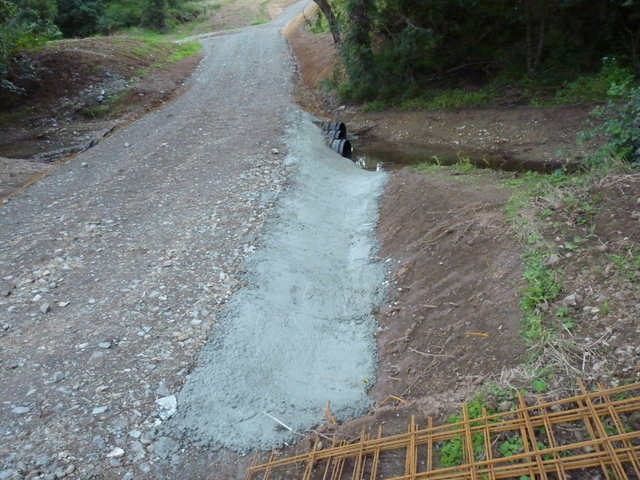
I haven’t built a concrete causeway before and the rough estimate of the amount of concrete suggested that it might be sensible to see if we could get the job done by a contractor. Unfortunately, we ran into a problem we have encountered before in this part of the world. Finding a contractor capable and prepared to do the job was not possible. “Yeah, I’ll drop around tomorrow or the next day” is apparently code for “Look, I have enough work and I don’t need shitty little jobs where I can only pick up ten or twelve grand for two days work”. Talking to others in the area it seems that this isn’t something that just happens to newcomers. A bloke we were talking to recently spent 3 months finding a tiler.
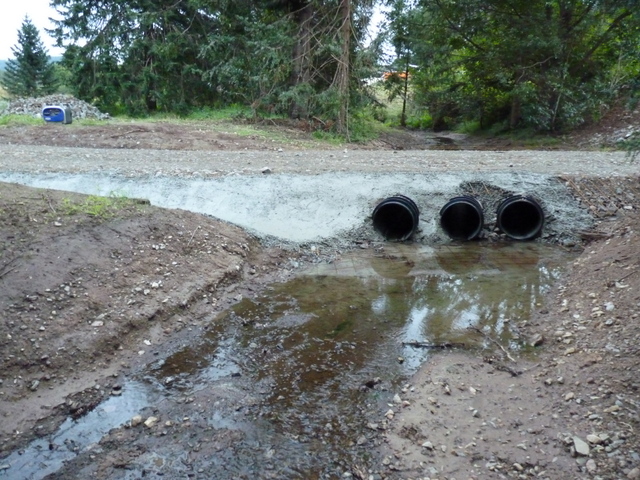
Yet again, I became just a little irritated by people who give a commitment and don’t deliver and decided to do it myself.
The objectives for this causeway were pretty simple:
- The running surface needs to be strong enough to carry a fully laden concrete truck without breaking up;
- The ‘shoulders’, ‘skirts’ and ‘aprons’ – not sure if these are technical terms but I mean the bits on the sides and into the stream – need to be capable of withstanding a considerable force of water without breaking up and peeling away while maintaining the integrity of the running surface.
I wasn’t very concerned about looks although it is always nice if it looks OK.
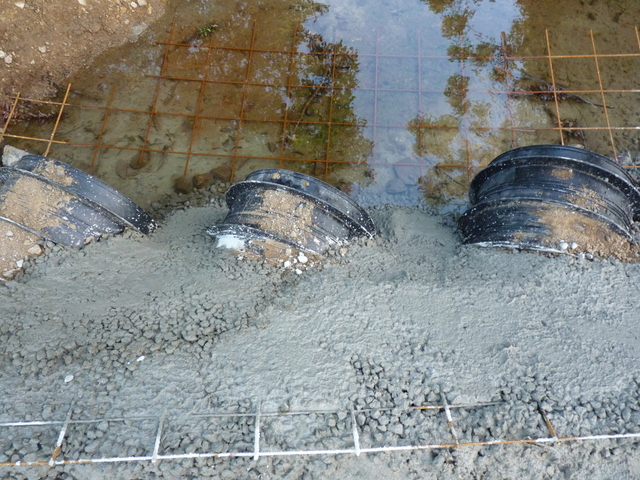
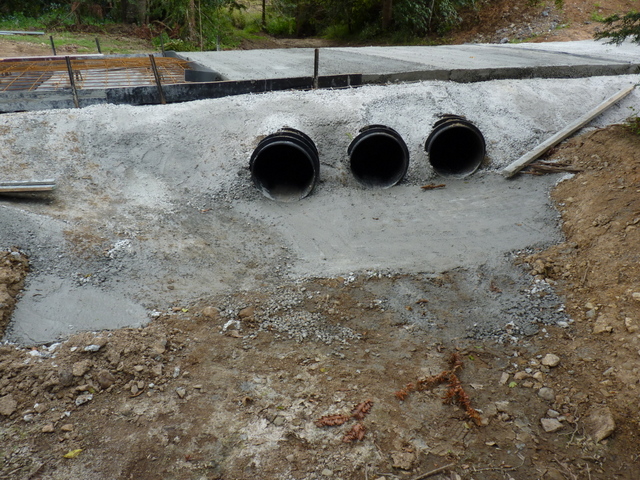
I read a number of articles about how to build farm causeways and, while they provided some help I wasn’t really wasn’t much the wiser. I looked at causeways that seemed to work and tried to replicate the key elements. I should say that the basic formation of the causeway had been carried out by the contractor who constructed the road. We had a well formed causeway with 3 x 500mm ‘Black Brute’ pipes properly installed and covered with rock and road base. All that was required was concrete.
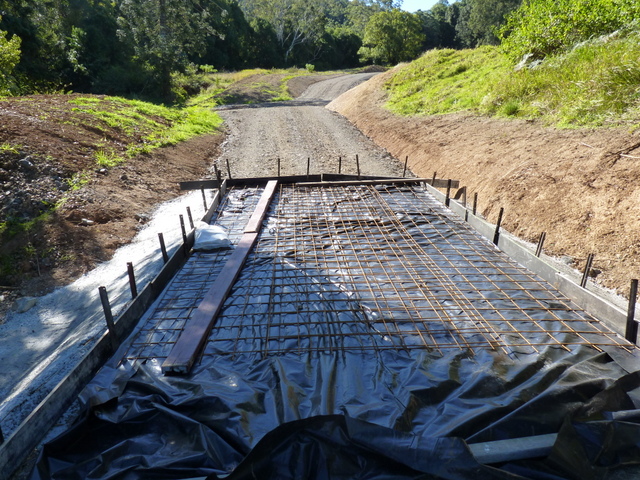
The plan was to, first, concrete the skirts and the aprons on both the up and down stream sides. There is a chance that we didn’t need the downstream cover to the same level as the upstream but I decided to put the same cover on both. The upstream apron was set into the stream bed 200mm. Reinforcing was placed in both skirts and aprons supported by 75mm chairs. Concrete at a minimum of 100mm thick was laid using a standard mix of 1 part GP cement, 3 parts 20mm drainage channel rock and 2 parts crusher dust (in lieu of sand). I kept the mix a little ‘stiff’ to assist in holding it in place on the sides of the causeway. The skirts and aprons took a little over 5 meters of concrete.
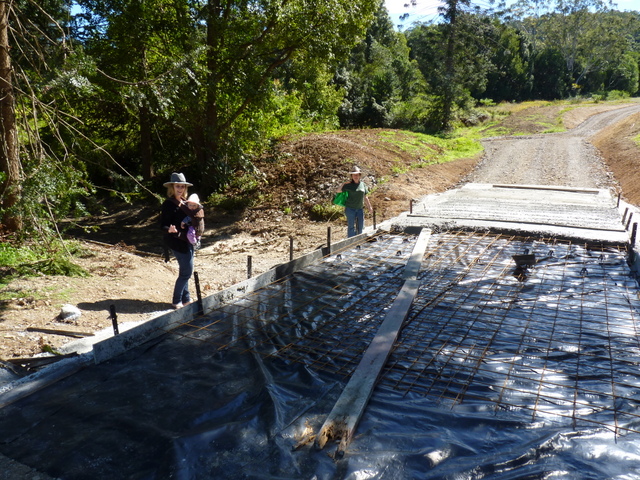
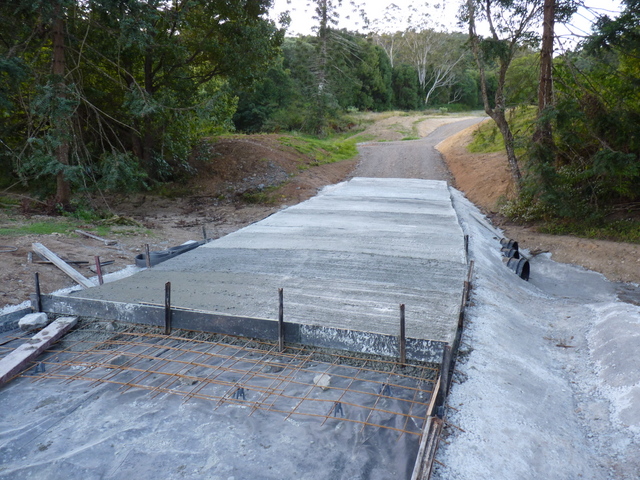
The running surface deserved a little more care and strength. I had intended to bring the skirts up to about 150mm to provide a bund wall that could be used in lieu of form work for the running surface. This didn’t pan out. I couldn’t really bring the skirts up that high and keep them strong. So I placed 150 mm form work for the running surface, laid builders plastic and reinforcing on a mixture of 75mm and 100mm chairs – with a few rocks after I ran out of chairs of either size.
I faced a decision at this stage. Bring in a truck or continue to mix by hand?
The150/160mm slab at an average of 3.6 x 18 meters was going to require 10 cubic meters of concrete. In this area the cost of 5 meters of concrete delivered was about $1,400 plus an additional $200 per load as a ‘Saturday’ surcharge. I would not be able to handle 5 metres of concrete on my own. With extra hands it might be possible, although with 2 of us, still tough.
Option 2 was to mix half the concrete myself and bring in a truck for the last 5 metres.
Option 3 was to mix the lot.
I decided to start out mixing and keep open the option of bringing in a truck for the last 5 metres.
As it turned out I developed a rhythm and mixed the lot. By the time I finished I reckon I had it pretty right.
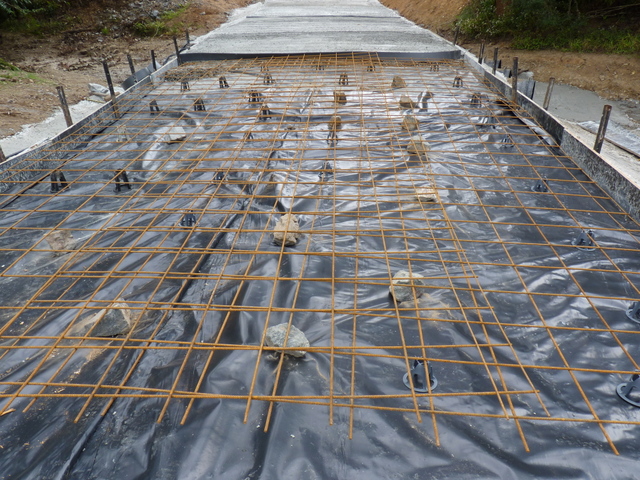
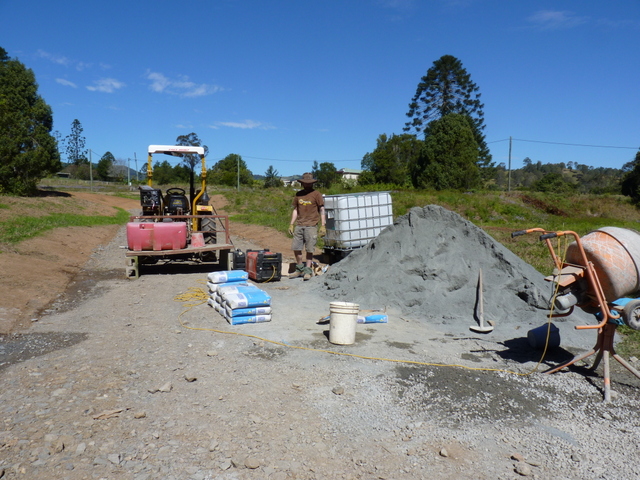
The total cost of the project was a little under $3000 in materials – Reo, builders plastic, 20mm aggregate, crusher dust and cement – and 11 days mixing, including a couple of days when there were 2 of us on the job. The record amount mixed in a day was 2.3 cubic metres, achieved with Adam and I working. The best I did on my own was 1.8 cubic metres. Early to bed that night.
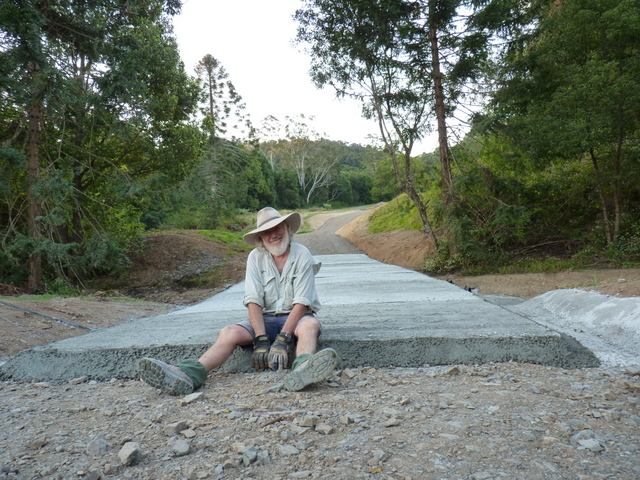
I used a mix that should achieve the 30MPA standard and, at the 150mm thick, should deal with a fully laden 25 tonne concrete truck but I will only be able to assess my performance on that criterion after the first truck, just as I will have to wait for a flood to see what effect that will have.
 bunyagully
well done. And here I was thinking you knew what you were talking about and that skirt and apron were technical terms!
That is a mighty fine looking causeway! I reckon you will be right re the trucks – given you have a properly filled rock base to it all, the concrete is just a capping. Give it a couple of weeks and that will be nice and strong. Also, I use skirts and aprons too – though am not a civil engineer so will defer to any experts out there…
10 out of 10 for effort…what a massive job!
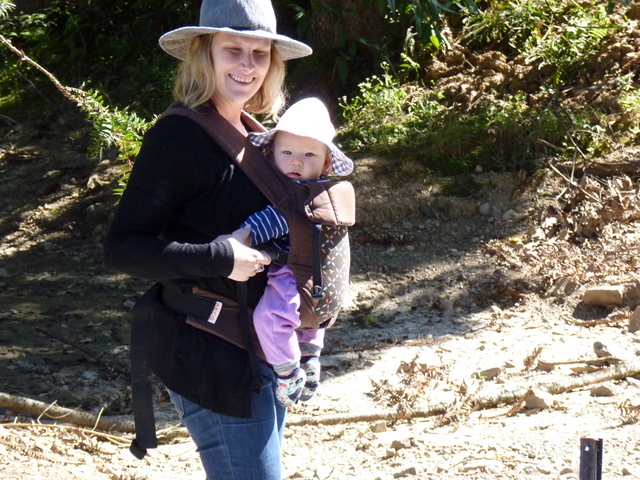
You Coles Mob sure know how to work hard! And looks like the newest Coles Clan member kept a close eye on the proceedings too! Well done! We’re referencing SlowFeet France, Spain, Andorra & Portugal Blogs as we travel around these parts!